I was always curious as to why there seemed to be two distinct types of Irish Crochet, but only recently discovered that there is named terminology for these two types.
Flora Klickmann, in “The Craft of the Crochet Hook”, says about Irish Crochet, “Generally speaking, there are two distinct classes of Irish Crochet, the popular bebe crochet and the heavy guipure kind.”

Klickmann’s book, published in 1912, came out during the time of decline in the Irish crochet fashion in the upper classes. The decline came not from a shifting of preferred fashion elements, but in the affordability of machine crafted lace and the ability to pile on the machine lace for a much lower cost. Unfortunately, we also see that trend in many middle and lower classes today with the rise of fast fashion and affordability of imported clothing. That wearable crochet style was what Klickmann termed, “guipure Irish crochet”. It involved repetitive botanical motifs and grounding assembled on a background cloth with the pattern and sizing traced on the surface. (Image above)
Depending on the density of the motifs, the finished product could be, indeed, very heavy. It was more of a statement of having the luxury enough to wear that level of art out in society.
In the height of Irish crochet fashion, many books and pamphlets were published teaching the upper and middle classes of society how to create their own pieces of Irish crochet lace. The majority of those first books published came from well known fiber arts teacher, Mademoiselle Riego de la Branchardiere in England as well as crochet thread manufacturers. They included patterns for collars, dresses, and basic techniques and motifs in the art in order to allow the crafter to design their own pieces. Over the next few decades the patterns shifted from making personal items and edgings, to items for infants (such as baptism garments and bonnets), then items for the home. That is when “bebe lace” appeared.
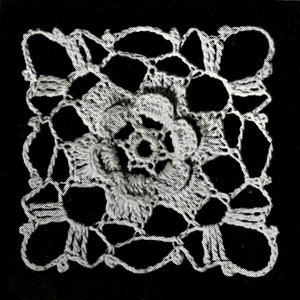
Between 1900-1915 patterns started being published using a square or hexagonal-based shape around a central motif in order to assemble a piece without the need of a background fabric or experience in creating grounding to connect the motifs. (I like to think of this as a more refined ancestor to modern granny squares).
The patterns were used for camisette yokes and corset covers as well as baby bonnets. Bedspreads and tablecloths at that point were still majority filet crochet, but slowly these patterns began to be published in larger squares for the sake of using for bedspreads and tablecloths. You can find many of these patterns of Free Vintage Crochet website.
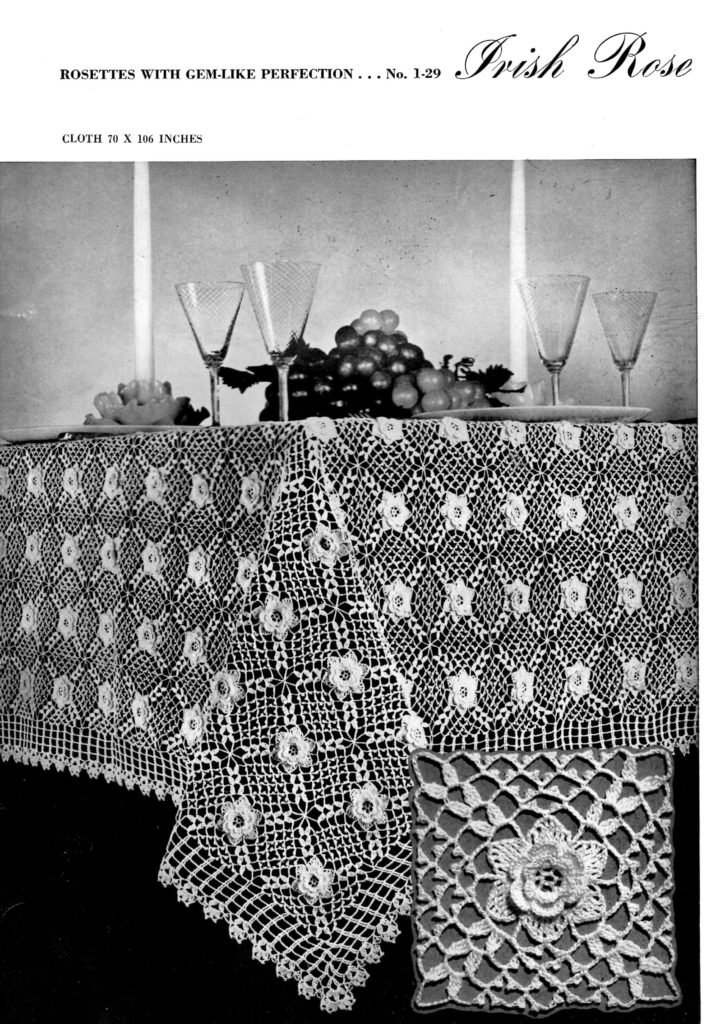
This tablecloth-turned-bedspread in particular was my introduction to Irish crochet in 2022. One of my oldest friends was getting married and her sister, who was a knitter, and I decided to make her the Irish Rose Bedspread for a wedding present. I am proud to say that she finally got it spring of 2024… nearly 2 years after her wedding.
- The Craft of the Crochet Hook: Klickmann- https://www.antiquepatternlibrary.org/html/warm/B-EN002.htm
- Free Vintage Crochet- Bedspreads- https://freevintagecrochet.com/crochet-pattern/bedspread-patterns
- FVC-Tablecloths- https://freevintagecrochet.com/crochet-pattern/tablecloth-patterns
 Dogwood Mountain Arts
Leave a comment